
Contingency and Rationality
|
Contingency and Rationality |
|
 |
By Nelson O. Crespo ROQUE
|
|
“God arranges everything in measure, Sat 11, 20 |
|
| Albert Einstein stated that science involves two acts of faith: The first of them in the objectivity of the truth. . The second, in the knowability of the reality that surrounds us, which implies that it is ordered according to reason. Without these premises, the procedure of empirical or applied sciences would be meaningless. Let us not forget that their hypothetical-probative method is based on the study of patterns that allow us to discover and state, even when there is an Uncertainty Principle, laws that in their field of action will be impassable in an almost total spectrum. If man can, with the reflective and abstract intelligence that is his own, come close to unraveling the secrets of the nature that surrounds him, of the Universe as a whole, it is because in the Universe a rationality, a wisdom, is deployed and manifested. allows it to become knowable and studyable. Regarding this, there is convergence of criteria, hence expressions such as: “nature is wise” or “the wisdom of nature” are heard. Therefore, the real bone of contention will not be the rationality or complexity manifested in the Universe in general, or in a living organism in particular, say an amoeba or a primate, but rather the intricacies of that rationality. In this regard, there are two options that, although nuanced, can be defined: 1. The primacy of irrationality, of pure and simple chance. The first option is to postulate chance as the first cause, that is, the absence of any vestige of rationality, the absence of any vestige of order, to engender, through anonymous motives and needs, mechanisms of self-organization and self-replication, insurmountable laws that , succeeding and surpassing themselves, tend randomly not only to order, legality, complexity and the fine balance existing in nature, but also to rationality, including reflective intelligence and civilization. The second option is to postulate as the first cause the existence of a rational causality that gives the Universe an order, a legality, a balance. A rationality that cannot be encompassed in a pantheistic way with nature itself. In other words: it is to postulate the existence of a Logos, of a Wisdom, of a Creative Reason, immanent and transcendent to the multiple natural processes and Creation itself. A “Being” that faith refers to with the word “God” and that it confesses, not only as the Principle and First Cause, but also as the One through whom the Universe is, and is as it is. These two “options” are summarized by Pope Benedict XVI with the following words: “Either we recognize the priority of reason, of the Creative Reason that is at the origin of everything and is the beginning of everything (…) or we maintains the priority of the irrational, which is why everything that works on our earth (…) would be occasional, marginal, an irrational product; (so that) reason (itself) would be a product (more) of irrationality (…) In short, one project or another cannot be tested (in a laboratory), but the great option of the Christian is the option for rationality and the priority of reason.” CAUSE-EFFECT The man of science knows that identical effects, in identical circumstances, presuppose identical causes. For this reason, to define the relationship that exists between contingency and rationality, the first step consists of establishing the conditions by which an element, an entity, is a consequence of a cause that precedes it. If we observe any element of nature, say, a mammal, we will see that this animal is finite, changing over time, or what is the same, “contingent.” Mammals in general, and each one of them in particular, need multiple factors that are beyond themselves to exist. For example: your parents gave you life, you need food and water to live, you need air to breathe, etc. In order to exist, every mammal depends on other elements that precede it and that make its existence possible. This is what it means to be “contingent.” |
||||
|
In this way, if each and every one of the elements of nature are interdependent on each other (hence the fine and fragile thread that weaves its balance), following the cause-effect principle, at the end of the chain the existence of of an element that is not conditioned by the outside, nor does it depend on other elements to exist. This element could not be, logically, a mutable element over time (contingent); so that it is not only the support of everything that exists (“necessary” element), but also, by not depending on other elements to be able to be, it has in itself the reason for its existence (“absolute” element).
Thus: “contingent is (using the words of Saint Thomas Aquinas), what can be or cannot be… Necessary is, on the other hand, what cannot not be.” Now, if space and time are not absolute, but come to be, this “absolute” element cannot be anything that exists within the space-time categories: it must necessarily transcend them. The above is valid for an insignificant mammal as well as for a galaxy cluster. Consequently, what makes the Universe be or exist cannot be something equal to the Universe itself (or any part of it); Well, given the mutability and continuous evolution of the Universe, this would imply contingency and not necessity (the Universe is, but it could well not be). In this way, if reality as a whole is an entity that “becomes”, the necessary cause that justifies its origin must be a reality that is beyond it, since what is true is that the Universe could not (even in its most primitive stages) operate without first existing. |
|||
|
COSMOGENESIS According to the cosmological theories in force today, the “studyable” genesis of the Universe (and we limit “studyable”, since Physics can only be referred in time until reaching the so-called “Planck time”, 10 -43 seconds), we must probe into the appearance of inert matter from what has been called a “singularity” or “single mathematical point”, a “point of inoperability” of the elements, to, from “non-time”, arrive to “Planck time”, and, from it, to this multifaceted Universe in continuous development and evolution. The Microwave Background Radiation that crosses space (3°K, about -270°C), will constitute a reality only explainable from the postulates of the Big Bang, constituting a kind of echo of the “instant” in which it appears in the cosmic scene space and time, matter and energy. The Big Bang is postulated by astrophysicists as the appearance, in the middle of an “absolute vacuum”, of a single “point” of maximum power. At the very moment of its appearance, this “point”, in which all matter, space, energy and time was contained, exploded, spreading its content in all directions (it is not that the elements spread and move away from one another). of others “through” space, but it is space-time itself that expands, and, with it, the elements contained in it). Time, therefore, had a beginning. But why can we affirm that time has had a beginning? According to the General Theory of Relativity, in the “instant” we call the Big Bang, the Universe would be in a state of “zero volume.” Its density would, therefore, reach an infinite value, like the space-time curvature. That “point” is what is known as a “singularity” or “unique mathematical point”; and it is defined as “mathematical”, for the simple reason that the space itself is contained in it (hence it does not yet “operate”), so that we cannot speak of “physical” or “geometric” dimensions. Now, mathematics cannot handle infinite numbers, so the General Theory of Relativity predicts that there must be a “point” in the Universe where this theory has no consistency. In reality, almost every scientific theory is formulated under the assumption that space-time is uniform and almost flat, so that none is capable of surviving at a point like the one described. The “singularity” will, therefore, be a “point” at which space and time disappear (not that they become zero, but that, as such, they are inoperative). But, in the instant before the Big Bang (if we can speak of an “instant”, since time does not yet operate), no Universe exists and the same questions that man has asked from generation to generation remain latent. generation, although now in a previous link of the chain: what is the First Cause of the existence of the Universe? Where do we come from? Where are we going? These questions exceed empirical sciences in any of their fields, since before the so-called “singularity” or “single mathematical point” (even more so, between that “singularity” and the so-called “Planck time”), there is no object of study. related to them; It would be like questioning Biology about what precedes life, in any of its facets. Is this perhaps the moment in which empirical sciences and faith rise from their seats and dance the waltz of concord? Certainly not. God should not be placed as a plug in the gaps that our knowledge cannot yet fill, since it is not only a question of knowing how or when the Universe materially emerged, but also of discovering what the meaning of such origin is: whether it is governed by chance, by a blind destiny, by an anonymous necessity, or by a Logos, by a Creative Rationality, immanent and transcendent to the Universe itself. From this, two considerations have been postulated: first, considering the Universe as an “object” entity that comes to be. Second, the consideration of the Universe as “non-object”, that is, as self-contained. “OBJECT” UNIVERSE Contemporary cosmological currents do not always turn the Universe into a caused object; That is, they do not necessarily refer to the Logos of natural Theology. For Francisco Soler Gil, for example, there are four ways in which attempts have been made to relate cosmology to natural theology, although with uneven and not always happy results. The first way has been to postulate a kind of concordism; the second, consider the temporal beginning of the Universe as Creation; the third, the consideration of the peculiar initial conditions of the Universe and, the fourth, the so-called Anthropic Principle. These four modes show the consideration of the Universe as intelligible and under the category “object”; not self-sufficient, but dependent in its existence on an element foreign to it as an efficient or necessary cause. The central point of this argument will be the consideration that every object has a cause and that the Universe as a whole is an object. If there were another object within the Universe itself that could be the cause of the “Universe object”, there would be no reason to deny, in turn, another cause of that cause, and so on to infinity. But let’s look at each of these considerations separately: 1. The first would be the postulation of a kind of “concordism”, according to which cosmology would describe a cosmogenesis similar to that reported in the biblical Genesis; so the collaboration between cosmology and Theology would be unison. According to this position, cosmologies would not be accepted that did not take the temporal beginning of the Universe as absolute, and it would also imply considering the biblical aphorism of creation as a univocal and literal narrative. Now, a serious error underlies this perspective: the substitution of study plans and methodologies; forgetting that “genesis of the Universe” and “divine creation” are different planes that we should not supplant or exclude; even in the case in which a type of cosmogenesis is presented that is incompatible with the admission of Creation, or a form of creationism (promoted by fundamentalist groups), which is incompatible with the theories that currently explain the genesis of the Universe. 2. A second perspective would be to consider the “temporal beginning” of the Universe as “creation”. This perspective entails a serious problem: confusing “Creation” with “temporal origin” and thus forgetting that the term “creation” has two meanings: |
||||
|
. First meaning: Creation, not “from” but “from nothing” (creatio ex nihilo); that is, what gives the absolute beginning, ontological beginning, to something existing. The “since” refers to a spatio-temporal precedent, a “before”, which ignores the fact that time is not an absolute element in itself, but that, together with space, matter and energy, it comes to be. . Second meaning: Creation as a manifestation of what is given and operates in something existing; so that we can call “creation” everything that exists The first meaning delves into the field of Metaphysics, of Philosophy. The second, in the empirical sciences, and it must always be specified in what sense the term “creation” is used and what scope and meaning is given to it.3. A third perspective would be one in which cosmology shows peculiar initial conditions that allowed the appearance of subsequent structures of the Universe, perfectly adjusted, as if following a meticulous plan. However, this position overlooks the fact that not all the initial conditions of the Universe imply the current Universe. |
|||
| 4. The fourth perspective is the so-called Anthropic Principle, according to which the Universe is designed to give rise to rational observers within it, either because the deployment of the Universe followed a very clear trajectory that made life possible first and then intelligent observers. (weak anthropic principle), or because from the beginning the emergence of rational observers in the Universe was inexorably marked (strong anthropic principle).
ANTHROPIC PRINCIPLE Why does the Universe have certain properties? Why is the Universe such that it allows rational beings to exist? These questions, since they do not have an answer or an experimental verification, leave the field of Physics, and any science that studies the matter, since, strictly speaking, they are aimed at delving into the operation of an already existing matter. , with the properties that are experimentally perceived to be operating in it. Is it legal to affirm that the existence of rational beings is the purpose of the Universe? There is no instrument that allows the category “purpose” to be experimentally measured, nor can it be included in a mathematical equation. How then can the existence of a purpose be inferred? Dr. Manuel Carreira, SJ, gives the following example: I can have a glass in my hand. How can I infer what it is made for? It is not enough to give the glass to a physicist. A physicist cannot prove that a glass is made to hold a liquid, rather than being made to serve as a flower pot or to hold pens on a table. How then can we know the purpose of a glass? The only logical way to do this is to study the consequences of that glass existing and determine what would happen if it did not. Well, this is exactly what physicists have done when formulating the Anthropic Principle (and it has been physicists, not philosophers, who have asked themselves about the characteristics of the Universe in relation to man and have formulated it). This is why we can ask ourselves: what would happen if the Universe had a greater mass than it does? The mass of the Universe in physical terms is considered to be approximately 10 56 grams. What would happen if instead of this it were 10 57, or what would happen if it were 10 55? When the consequences of this change are calculated, an unappealable conclusion is reached: we simply would not be here. When studying elementary particles, it is observed that the proton, which is the unit of positive charge, has the same charge as the electron; but the proton is 1,836 times heavier than the electron. Because? What would happen if instead of 1,836 it were 2,000 or 1,500?: we would not be here. In Physics we talk about four forces, and only four. All physics has to be explained as the activity of four forces: gravitational, electromagnetic, strong nuclear and weak nuclear. If we compare the electromagnetic force with the gravitational force, it turns out that the electromagnetic force between two electrons that repel each other, but are attracted by gravitational force, the repulsion is approximately 10 to 40 times more intense than the attraction. The electromagnetic force is incredibly more powerful than the gravitational force. Could we change it to be 10 41 or 10 39?: We wouldn’t be here. And once we have seen the properties of matter at its largest: the mass of the Universe, the gravitational force (which is what structures galaxies); and we have seen the electromagnetic force (which is what produces atoms, molecules, living structures), and we compare those forces with the nuclear force, which is what allows elements such as carbon, oxygen, iron, calcium, to exist. all of which are necessary for life, we can wonder about the planet Earth and its star Sun. Our Sun is a star a little larger than most stars. But what would happen if it had 10 percent more mass? We wouldn’t be here. What if it had 10 percent less mass? We wouldn’t be here either. What if planet Earth were 10 percent closer or farther away from the Sun? We wouldn’t be here either. What if the Earth had 10 percent more mass? We wouldn’t be here either. What if there was no Moon?: we would not be here, etcetera, etcetera, etcetera. So the variety of constants that exist in the Universe lead us to say: we are really here today because the Universe operates meticulously, with some adjustments and with extraordinary accuracy. And why does the Universe operate like this? By chance? By chance? Saying that it is by chance, saying that it is by pure and simple chance, is the same as saying that it is “just because” (and “just because” is the most irrational and unscientific of answers). “Chance” in the field of empirical or applied sciences only has one way of calculating: the probabilities that something can happen in one way or another are calculated, and then it is stated that something happens in one way or another, with greater or less frequently, with greater or lesser probability. Now, this is not applicable to the Universe. Because? Firstly, because there are not two, three, four or ten universes to make comparisons between them and see if their properties and constants appear or disappear spontaneously: our Universe is unique. Secondly, chance is not a physical category, it does not explain, predict or corroborate anything, so we cannot resort to it from the empirical sciences to physically explain the existence of the Universe. Furthermore, when there is only one object, when there is only one mathematical variable, such as the Universe, it is not possible to perform a probability calculation. So what’s left? We could say that the Universe is as it is due to a finalistic decision in which the Creator, who is responsible for the Universe existing, creates with a purpose, and we can infer the purpose precisely from that whole series of adjustments that allow beings to exist. humans exist and that we are here today. Hence, the rationality manifested and operating in the Universe allows a rational being, who comes from it, to know it (this is why science “works”). If man is constituted by an evolutionary process, he is not an entity foreign to that from which he comes. Reciprocity must occur. And this is precisely what the Anthropic Principle affirms: the Universe has to be made in such a way that it corresponds to the rational and cognitive endowment of man, since it comes from him. “NON-OBJECT” UNIVERSE In contemporary cosmology, models are also postulated that make the Universe a “non-object” element, that is, without an external foundation or necessary cause for its existence, as a kind of self-contained entity without an external cause. One of the main current champions of this consideration is Stephen Hawking. According to this perspective, the Universe would not have its beginning in an original singularity, nor an ontological beginning trigger external to the Universe itself. For Hawking, the non-necessity of a “causal element”, independent of the Universe, would be evident in a Universe that explained itself. The condition of possibility of establishing a self-contained, self-sufficient and self-explainable Universe would lie – according to Hawking – in the assumption that the creation or appearance of the Universe can be explained from a supposed “nothing”, taking the quantum vacuum as such. |
||||
|
Now, Hawking’s “borderless” Universe model requires for its formulation a mathematical concept called “imaginary time”, time that is not the time in which our “experiential universe” is confined, in which there will always be a singularity, a beginning of time.
In this regard, Hawking specifies in his work History of time : “When we return to the real time in which we live, however, there will still appear to be singularities… In real time the Universe has a beginning and an end in singularities that form a space-time boundary and in which the laws scientists stop working…” Only if we move in an imaginary time will we find that there are no singularities. And here Hawking expresses the crux of the matter. Those who affirm the spontaneous birth of the Universe use ideas that recall the absolute space and time of Newton, who proposed that these existed separately from matter. In recent years, it has been postulated, however, that primitive matter could arise from space-time structures, and that these structures could appear from fluctuations in the quantum vacuum. |
|||
| In science there are “paradigms” (some specialists such as Mariano Artigas have called them “fashion”), which are usually supported by the prestige of some scientists or by the success of a theory. One of the best-known “fads” was the idea of absolute space and time from Newtonian Physics. It lasted more than two centuries (it is what the materialist currents that flourished in the 19th century are based on, for example Marxist Philosophy), and its reality was accepted, with some exceptions, until in the 20th century, Einstein’s Relativity showed that these were incorrect ideas. Now it has become fashionable to talk about the implications that quantum cosmology could have with respect to the creation of the Universe. It is a paradigm that has points in common with Newton’s absolute space-time, in which a certain reality is attributed to space-time structures.
This would seem to be supported by Einstein’s General Relativity, which presupposes a certain “geometrization” of Physics, even when physical realities cannot be rigidly reduced to geometric concepts, since, although it is true that Einstein theoretically replaced forces with curvature of space-time, it is an effective and legitimate stratagem, which has nothing to do with the reduction of Physics to Geometry or with the existence of a space-time without matter. On the other hand, the “void” that Physics studies has no relationship with “nothing”. “Nothing” is a metaphysical term, not a physical one. In Physics we cannot speak of “nothing”, since we would leave its field of study (if there is nothing, there is no Physics). What Physics calls “vacuum” is the state in which an area of space is found after extracting matter in solid, liquid or gaseous state, and radiation from it. However, although technical progress allows us to obtain increasingly perfect voids, what is achieved is not “nothing” in an absolute sense. How could it be achieved? Nothingness does not exist as a physical category. It is a concept that, in addition to having no place in Physics, cannot be related to any experiment, even when there are different types of “vacuum”, according to the theories and methods used; for example, the classical vacuum or the quantum vacuum. How would a physicist manage to produce nothing, or produce something from nothing? To achieve this, Mariano Artigas points out, we do not need physicists, but magicians. On the other hand, the quantum vacuum is anything but empty, in it the energy can never be stabilized at a zero value, it is fluctuating around that value, all types of particles, therefore called “virtual”, are continually being created and annihilated. in which the product of its energy times the time of its ephemeral existence is less than the quantum of action. In other words: the self-creation of the Universe is based on two extrapolations that are difficult to justify, from the point of view of empirical sciences. Firstly, physical theories can only be considered “scientific” if their hypotheses can be subjected to the control of an experiment that somehow corroborates their predictions. Well, absolute nothingness, metaphysical nothingness, is not, by definition, something that can be related to any type of experiment (neither real nor possible), therefore, it is an idea that falls totally outside the field of study of empirical sciences. On the other hand, the “quantum vacuum” of Physics should not be identified with the “absolute nothingness” of Ontology. From General Relativity we could extract the idea that space and time can be considered structures independent of matter. However, what the General Theory of Relativity states is that the areas where there is matter are, from a mathematical point of view, regions in which space-time has a greater curvature, which would be material bodies. In this way, when a scientist postulates that the Universe could have created itself from “nothing”, or from the “quantum vacuum”, he should not (nor can he) refer in any way to the concept of “nothing” used by science. Metaphysics or by Theology, but that supposed “physical nothingness”, from which the Universe would arise, would have to be, in some way, not an absolute void, but “something”. Secondly, the theories that expose the self-creation of the Universe are based on the combination of multiple elements from various scientific theories; elements that constitute precisely its most controversial points. For example, from quantum mechanics we take the controversial idea that there are “caused phenomena” and the claim that matter can be created (and annihilated). These statements require qualifications and their meaning must be limited to the field of Physics. Extrapolating them beyond Physics is an error and a supplantation of plans and methodologies (the same thing that happens with fundamentalist concordism), and this is precisely what happens when we try to use these theses to affirm the self-creation of the Universe. In summary, the theories that have postulated the self-creation of the Universe are based (at least currently) on highly hypothetical mathematical statements and postulates (difficult to corroborate experimentally), in combination with debatable theoretical elements; as well as with the semantic transmutation of some terms used by various branches of empirical sciences (and even Philosophy and Theology), which become used with other meanings, so that they are intended to be given a certain physical meaning. when, either their original meaning is philosophical, or they are taken from other scientific theories in which they had a different original meaning and function. EXPULSION OF THE CREATOR? Paraphrasing Stephen Hawking, we could say that “expelling the Creator” has been one of the essential priorities of the defenders of the theories of the “self-creation” of the Universe. Now, if we want to be rationally rigorous (so philosophical and ideological prejudices must be left aside), we will come across the fact that, even accepting the hypothesis that the Universe created itself, it does not can rationally ignore the reference to a Creator. Because? For the simple reason that the Universe has an origin, whatever it may be, and a structure that is the result of physical laws that make it what it is. Well, if the Universe creates itself, it will do so because certain physical laws cause it to originate. Now, what is the origin of these laws? They could not originate with the Universe, since they must be in some way prior to it to be able to originate it, nor could they originate themselves, since nothing can be cause-effect of itself. In this way, even accepting the consideration of the Universe as a “non-object”, even accepting the hypothesis that the Universe was self-contained and self-created, from reason we cannot veto the acceptance of the existence of a Logos, of a Creative Rationality, of a Creator. The science that studies “natural creativity” is, in this way, faced with the paradox that the explanation of creative phenomena is not achieved by any of the results of natural creativity: the effect converted into a cause of itself implies the absurdity of having to operate before existing in order to cause itself. In other words: the being and operation of nature cannot arise from any natural operation, no matter how creative it may be. Furthermore, “natural creativity” itself implies rationality, since in the development of nature not only “dynamism” and “modeling” (the emergence of new models or spatio-temporal structures) are important, but also the “information”. Nature functions as a set of “instructions” that are stored, encoded and decoded, making dissimilar natural systems possible; a kind of “materialized rationality” with very specific and ordered functions; in very tight harmony with other processes and their own instructions. The “information” acting in nature allows, in this way, to perceive a series of potentialities that unfold as if following a meticulous plan and this makes our Universe a world of various levels of emerging complexity, open to new structuring based on the existing latent potentialities and the interaction with the environment itself, with the environment itself. In this way, the natural evolutionary phenomena that have been studied and assimilated into the contemporary worldview are far from being presented as blind or ontologically random; Rather, the new worldview has forced a reinterpretation of evolutionary phenomena based on the notion of self-organization: in the Universe there is a combination of random phenomena and necessary phenomena, of variations and selections, which allow us to register a real directionality in the evolutionary phenomena. In this way, Quantum Cosmology does not violate but rather highlights the “object” condition of the Universe, since it continues to be an independent, closed, original and unique entity, although theoretically “parallel universes” could have developed that as a whole would continue being and meaning in itself: “the Universe”. |
||||
| On the other hand, the reference to an infinite causality as an explanation would come up against the fact that each successive cause from which we would like to derive our Universe would have the same characteristics as the Universe itself, so the foundation or cause of the Universe As a whole, it must be foreign to him, independent and not derived from him; and with this the eternal questions of the human being remain: how did the Universe have its origin? Will it have an end? What is man’s place in the cosmos?
In this regard, an episode that occurred between Stephen Hawking and Pope John Paul II is interesting; episode made public in 2004 by Monsignor Józef Zycinski, archbishop of Lublin, Poland. |
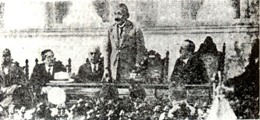 Albert Einstein in the auditorium of the Academy of Sciences of Havana, 1930. |
|||
| Zycinski says that shortly after Hawking presented his model of a self-created (self-contained) Universe in the Vatican (Hawking is a member of the Pontifical Academy of Sciences), in the presence of Pope John Paul II, he commented on several occasions who expected – as in the Galileo case – a condemnation by the Church; but that Pope John Paul II had disappointed him, since, without feeling offended, he had listened to his version of the “Creation of the Universe”, in which not the slightest mention of God was made. Monsignor Zycinski continues narrating that, in a meeting with the Pope at the pontifical residence of Castel Gandolfo, he had the opportunity to tell him that Hawking was disappointed at not having received any condemnation from him, to which Pope John Paul II responded:
“Why should I have started arguing with him? A physicist should not talk about a creator God: that is the task of theologians. But a physicist cannot prevent a theologian from asking questions such as: why are there laws that govern the Universe or why can mathematical language be used? I do not believe, Pope John Paul II concluded, that Hawking is opposed to such questions. That is why I see no reason for a conflict.” CONTINGENCY OR RATIONALITY? Therefore, what makes the Universe be and operate?: contingency or intelligence? Contingency or rationality? It is enough for us to contemplate the human being, the culmination of Creation, and we will realize that he is not only (as Carl Sagan said): “Stardust contemplating the stars”; he is much more. The human being is, despite his contingency: “Stardust rationalizing the stars.” Those stars, that Universe, which has been arranged by the Creative Reason, by the Eternal Logos, not like dice thrown randomly into the air hoping to obtain a harmonious whole from them; but a meticulously structured Universe, which is, in the midst of its diversity and heterogeneity, “a Whole” monolithic and indivisible, arranged with measure, number and weight (cf. Wisdom 11, 20). Measurements, numbers and weights without which our essential empirical or applied sciences could not even remotely operate. And this constitutes a reality that no one, even halfway sensible, would even dare to question, neither from praxis, nor, even less, from reason. |
||||


|
-Carlos Alberto Marmelada Sebastián: Current Cosmology, Philosophy and Religion, Aceprensa, September 15, 2000. |