
Creation and Evolution
|
|
 |
||
|
“Creation and Evolution”
Opening Remarks of the “Creation and Evolution” Symposium, held at the “San Juan María Vianney” Priestly House from October 29 to 31, 2009 |
||
|
for Nelson O. Crespo Roque
|
||
With joy we begin the “Creation and Evolution” Symposium, organized by the Reflection and Service Group of the Archbishopric of Havana. Both creation and evolution, due to the multiplicity of existing theories and criteria in this regard, always arouse interest and, on many occasions, exacerbate passions. If we consult specialized literature, if we talk with specialists or if we navigate cyberspace, we will rarely find this binomial intertwined with the conjunction “and”, but rather, presented in a contradictory way, say: “Creation versus Evolution”, “ Creation or Evolution”, “Creation Vs. Evolution”, etc.
Therefore, when talking about creation or evolution we must ask ourselves: are we referring to homologous elements or are we talking about topics that are radically antagonistic and irreconcilable with each other? As an exordium, we must specify that creation and evolution are different realities, both in their respective study methods and in each of their areas of competence. The term creation refers to the origin of something “from nothing”, while evolution stands on the basis that, in order to operate, it needs “something pre-existing”; that is, of something that is capable of changing, of evolving, because in the material framework, in fidelity to the praxis of empirical or natural sciences, nothing comes out of nothing, hence evolution in itself does not create, but it only transforms what already exists. In addition to the fact that from the so-called “Planck Time” (10 -43 sec.), moment in which the currently known physical laws begin to operate, matter is neither created nor destroyed, it is only transformed, as stated. the Laws of Thermodynamics. In this way, when an astrophysicist postulates the Big Bang , and reports that a singularity or a single mathematical point exploded and began to expand until it reached our current Universe; That singularity, that unique mathematical point, is not nothing, but “something”, since, evidently, nothing cannot explode or expand. Hence the illegality of trying to identify the Big Bang with Creation, as some concordist or fundamentalist groups have attempted to do. Similarly, when a biologist postulates that due to mutations or natural selection a cell (both a prokaryotic and a eukaryotic cell), an organism, a less evolved species, gives rise to another more evolved one; That cell, that more evolved species, does not come from nothing either, but from a previous element, since it is evident that what does not yet exist cannot change or evolve. The material evolution of the Cosmos, both in its original moments and in its ultimate end (the thermal death of the Universe), has very precise limits. Although in this regard we must specify that it is not permissible to identify “Beginning” with beginning, nor, even less, end with “Finality”. If our Universe exists, if we are here today, it is because it is not eternal, otherwise, neither our sun nor any star could shine, because, after billions of years of evolution, all of them would have already become into white dwarfs and, after this stage, they would have lost every last bit of energy and would definitely be stars without light, in resolute and irreversible agony, which would leave no possibility for us to be gathered in this room today. Let us now specify what creation is. The term creation has several meanings, but in view of the topic at hand, we can reduce it to two: one of them is the mere name of our environment, for example, when someone is on a beach, contemplating a sunset, and affirms: I am ecstatic with the beauty of creation! This meaning of the term, however, does not create discrepancies, but rather when it is referred to creation “ex nihilo”, that is, to the creation of nothing. These discrepancies are well justified, and not precisely because of ideological or philosophical affiliations, but because, even when we try to avoid it, each of us, even instinctively, analyzes and visualizes the world around us based on what is palpable by our senses, for example. the empirical, by what we ordinarily call: “the natural”. And here we fall into the crux of the matter. As a rule, we call “natural” what is palpable, what is empirically verifiable, while everything that falls outside this spectrum we classify as “supernatural” or, worse still, as “anti-scientific.” But when is it legal to say that something is natural and when is it legal to say that something is supernatural? To answer this question, let’s take a trivial example: imagine that we are in a park where there are some pigeons perched on a bench, suddenly we see that a dog comes, barks at them, and the pigeons fly away. Are we facing a natural event or a supernatural act? The answer is obvious, we are facing a natural act. But why can we say that we are dealing with a natural act? Simply and simply because barking is something in the nature of dogs, in the same way that flying is something in the nature of pigeons. Let’s now reverse the perspective and imagine that we are in the same park and it is the dog who is now on the bench. Suddenly some pigeons come, bark at him, and the dog flies upwards. Are we now facing a natural event or a supernatural act? Everyone will answer, correctly, that we are facing a supernatural act. Because? For the simple reason that barking is not in the nature of pigeons, in the same way that flying is not in the nature of dogs. From the above we can conclude that the definition of the act of barking or flying as something natural or as something supernatural is not determined by the act itself, but, rather, by the nature of the person who performs it. That a dog barks is something natural to the extent that barking is something typical of dogs’ nature, flying is not; Similarly, for a pigeon to fly is something typical of its nature, barking will never be. Following this line of analysis, when we talk about Creation, or to be more precise, when we talk about God as Creator, are we talking about something natural or something supernatural? Although for the vast majority, even for people of deep faith, this may sound contradictory and even scandalous, speaking of God as Creator is not something supernatural, but something natural. Because? For the simple reason that the creative act is something typical of the essence, of the divine nature. A human being will never be able to create absolutely anything in a laboratory from nothing, not even a simple amino acid (although amino acids are not simple at all). Because? Firstly, because the creative act is not something typical of human nature and, secondly, because creation is not a mere change, nor a mere movement, but an ontological act. Creation is what makes something that does not exist come into being, develop and remain. If the human being were to one day manage to produce amino acids in series in a laboratory, he could only do so from already existing elements that he would have before him in the laboratory; Man would make these elements react under well-controlled and precise conditions, processes and regulations that, rationally, intelligibly, would allow their “creation”, but he could never “create” them randomly or arbitrarily; even when in the Universe there is a combination of random phenomena and necessary phenomena, variations and selections that allow us to register a real directionality in evolutionary processes. For this reason, creation “ex nihilo”, if we refer it to the nature of God, is not something “supernatural”, but, rather, something suprarational for man or, if you want, supraempirical; since God is not a material entity and, consequently, is not subject to spatiotemporal categories. Let us not forget that God, by idiosyncrasy, is not something that exists, but rather his Being is above all existence. For this reason, we will never be able to analyze God chemically in a laboratory test tube to know his chemical composition, nor, no matter how wise we are, will we be able to create a “dio-simeter” that mathematically quantifies how many kilograms God weighs. , or how many centimeters, kilometers or miles it is in extension. God, we reiterate, is not a material element, therefore, in Him there is no magnitude that is empirically measurable or quantifiable. Hence, we cannot define Creation or the existence of God (empirically speaking) either as something scientific or as something anti-scientific, since God transcends any science that studies matter, and also the Universe itself. The above may seem to some to be a kind of blind faith or irrational fideism, but it is not. If we stop along the way and look at our environment, we will see that there are multiple analogous examples. Let us always keep in mind that, as |
||
| Antoine de Saint-Exupéry points out in his work The Little Prince: “One only sees well with the heart; The essential is invisible to the eyes”.
The human being is a free, rational and thinking creature; he is, in a word: an intellectual creature. But he is not only that, the human being is also a creature capable of loving, feeling, laughing and crying. Now, will we one day be able to build a “love meter” or a “friendship meter” that will mathematically, as a percentage, quantify the degree of love, friendship or hate that may exist between two people? |
Between matter and spirit there is a discontinuity. |
|
| Of course not, neither love, nor friendship, nor hate, nor any human feeling, is associated with matter, nor is it regulated by any of the four primordial forces that govern and define it; in the same way that intelligence or reason cannot be considered mere fruits of a highly evolved matter, and that does not mean that anyone would dare to classify love, friendship or reason as something supernatural or as something unscientific. Let us not forget that in the material framework matter is neither created nor destroyed, it only transforms; which is why it is impossible for matter to transform into something that it intrinsically is not. Or is it that love, friendship, or any other human feeling, is a mere reaction between neutrons and protons, or a simple fruit of the chemical reaction between hydrogen, helium, oxygen, or any other element of the Periodic Table?
Neither the force of gravity, nor the electromagnetic force, nor the strong nuclear force, nor the weak nuclear force, which are the four forces that govern and define matter, generate, nor will they ever generate, intellect, reason, love. , hatred, nor any action or feeling of a spiritual order. Pascal said that we are “thinking reeds.” Our first duty, therefore, is to learn to correctly use our ability to think and reason. Correctly understood, there is no incompatibility between creation and evolution. Furthermore, evolution presupposes creation, since it is the only one that can provide that “something” that evolution needs to be able to operate. Hence, even when creation and evolution are fields of study independent and autonomous from each other, even when they are orders of knowledge that we should never supplant; Yes, we can speak, without falling into concordism, of a “continuous creation” or an “evolutionary creation”, since, if the material universe operates by laws that regulate it, these laws could not originate from matter, given that precede it, nor, much less, could they self-create themselves, since nothing can be cause and effect of their own being. If the empirical sciences work, and they work well; If we have stepped on the surface of the Moon and discovered the human genome, if we have known the infancy of the Universe and with just the press of a key we can send a e-mail anywhere in the world, it is because our universe is governed by a series of laws that make its study and the development of science and technology possible. Otherwise, if our universe were an eternal and random chaos, both the development of technology and the development of any experimental science would be impossible. Because? En primer lugar, porque el azar no es un término físico y, en segundo lugar, porque él no es algo que pueda ser estudiado, predecible, ni reproducible en un laboratorio. Let us not forget that one of the fundamental axioms of empirical sciences is: “Extraordinary claims require extraordinary evidence.” |
||
| That is why we can affirm that, if our universe is governed by laws, if our universe is reasonable, as in fact it is, it is because there is a Reason that transcends it, hence the discovery of the laws that have made the Evolution is not something incompatible with Creation, nor with the existence of a Creator who, precisely because he is, can, through his transcendent causality, not only make them be, but also make them remain and evolve in time.
Only a chaotic evolution, only the absence of laws that govern the Universe, could oppose Creation. However, a chaotic evolution, an irrational evolution, would never be evolution, for the simple reason that chaos, chance, simple and simple universal anarchy, would oppose the slightest possibility of a complex structure being formed, maintain and reproduce itself. And natural selection can choose what has in itself the capacity to remain, but it does not confer stability if it does not possess it; She gives preference to the fittest, but does not constitute them as such. |
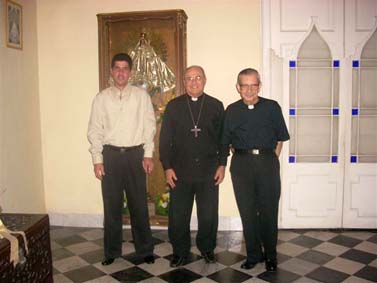 From left to right, M.Sc. Nelson O. Crespo Roque, BE. Cardinal Jaime Ortega Alamino and Dr.Sc. Manuel Carreira Vérez,s.j., after the closing of the Symposium. |
|
| This is why the Church does not oppose evolution, although it does ask scientists to be faithful to their specific field of research, since true experimental science, by restricting itself to the material world, can be neither atheist nor believer, but rather objective, and I insist, experimental science must and has to be objective. Therefore, beyond the philosophical affiliation held by one scientist or another, when a scientist speaks as a scientist he should not, nor can he, deny or affirm Creation, since this would go beyond his scope and his method of study to get involved in the field of Philosophy or Theology. It is also not the function of the Church to enter into questions of the empirical sciences, they are not the responsibility of the Church, but rather of researchers; although the Church does have the moral obligation to intervene to explain the ethical and religious consequences that such issues entail. Let us not forget that there are countless scientists who are believers and countless illiterate people who are atheists, therefore, the affirmation or denial of Creation is not determined by praxis, but by being.
Even though we cannot cloud history and forget that unfortunate clashes have sometimes occurred, we can affirm that the Church holds science in high esteem. In this regard, Pope John Paul II, addressing the scientific community, stated: “The Church (is not your enemy), it is your ally” (Castel Gandolfo, September 12, 1982). That is why, although the mission of the Church is not to do empirical science, but to make Jesus Christ unforgettable, its mission is directed towards man and his relationship with God. Man, in this way, is the path of the Church, and one of the most excellent fruits of human rationality is precisely the development of science and technology. For this reason, the development of science must always be encouraged, promoted and disseminated by the Church; and at this point we must all make a “mea culpa” and recognize that, sometimes, the Church, without falling into concordism, or the supplantation of fields of knowledge, should do more in the face of evangelization. , of the data and results of modern science; something that will never be detrimental to natural theological truths or Revelation, but quite the opposite. In this regard, the words that the philosopher Jürgen Habermas once expressed to the then Cardinal Ratzinger, now Pope Benedict XVI, are always recurring: “the Church needs thinkers capable of translating the coded convictions of the Christian faith into the language of today’s secularized world in order to thus making them effective again.” In the same way that the psalmist says that the heavens proclaim the glory of God, scientific discoveries, the development of technology, also proclaim the glory of God, since they are a reflection of one of the most precious gifts with which God has endowed the human being. man: reason, intellect. If man can do science it is because he is endowed with a rationality that is a reflection of the imprint that Reason, the Eternal Logos, has left on him. This is why scientific discoveries, far from distancing us, bring us closer to God, since, precisely, there is a rationality that underlies the Universe and transcends it. Because there is a human rationality capable of analyzing it, experimental science works. And this, “the coincidence between objective reason and subjective reason, constitutes, in the words of Pope Benedict XVI, an enigma and a great challenge because we see that, ultimately, there is one reason that unites them both: our reason ( subjective) could not discover the other (objective), if there were not an identical reason at the root of both” ( L’Osservatore Romano , April 14, 2006). In other words: In the Universe there is a single reason with several dimensions. To conclude, let us now point out some points: First of all, we must always keep in mind that truth can never contradict truth. Therefore, neither revealed truth nor scientific truth can contradict each other; nor can they nor should they be used or manipulated ideologically; nor, even less, hide behind science or the Church for ideological purposes, whether they are from the right or the left. Secondly, the Bible has never had an experimental scientific purpose, but rather a religious one, therefore, it is not legal to try to search for scientific postulates in it (neither with respect to the doctrine of the material origin of the Universe, nor with respect to the biological origin of man. , nor with respect to any other experimental consideration). Thirdly, for the Church there is no incompatibility between creation and evolution, although there is between evolutionism and creationism, which, in themselves, are not sciences, but philosophies. Fourthly, on the question of the origin of the human being, an ontological leap is made. With respect to its corporeality, the Church accepts without hesitation that the theory of evolution is, in the words of Pope John Paul II, “more than a hypothesis” ( L’Osservatore Romano , October 25, 1996); But, in the case of the soul, because it is spiritual, the Church does point out that it requires direct creative action on the part of God, since what is spiritual cannot be the result of something that is not spiritual. Fifth and finally, between matter and spirit there is a discontinuity. Spirit does not flow, nor can it flow or emerge from matter. In the human being there is an ontological leap of a transcendent nature that is expressed in his consciousness, in his freedom, in his intelligence, in his will, in all those attributes that identify him precisely as a “human being”, attributes that cannot be achieved. be explained. from the matter. Pascal describes this ontological leap poetically, but very accurately with these words: “Man is nothing more than a reed, the weakest thing that exists in nature; but it is a reed that thinks. It is not necessary for the entire universe to rise up against him to crush him: a vapor, a drop of water is enough to kill him. But even if the universe crushed him, man would still be nobler than what kills him, since he knows that he dies and knows the superiority that the universe has over him, while the universe knows nothing.” It is to expose, deepen and debate on these and other aspects that we have met; Because not only matter evolves, but also thought, sociology, personality, culture, and many other aspects of our daily lives. On behalf of the Reflection and Service Group of the Archbishopric of Havana, we give each and every one of you our most cordial welcome and declare this Symposium open, the fruits of which we entrust to the Blessed Virgin Mary, Sedes Sapientiae , so that, through her maternal intercession, Everlasting Wisdom helps us with her breath, not only to understand, but also to meditate on what will be debated in these days and, at the same time, grant us the necessary humility of spirit to recognize that As Father Félix Varela socratically stated, “among us no one knows and we all aspire to know.” |
||